FireFLY
Our Products
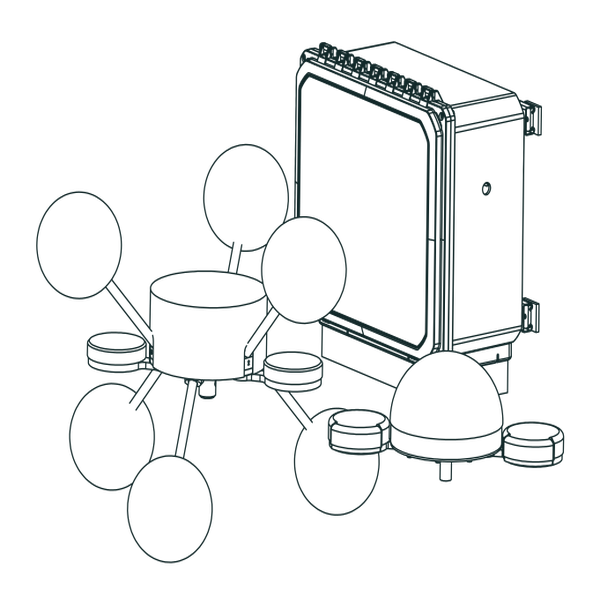
Hyperion Technology Group of Tupelo, MS actively employs a passive threat detection system known as FireFLY (hostile Fire Fast Locating sensor) for military and law enforcement applications. FireFLY is an acoustic, networkable hostile fire detection technology designed to detect, geolocate, and classify various threats including Small Arms Fire, sniper fire, Rocket/Artillery/Mortar, heavy machine gun fire, and Unmanned-Aerial-Surveillance (UAS) vehicles. Since 2012, the core technology has been under continuous iterative development and fielding under sponsorship of the U.S. Army Research Laboratory and U.S. Army Combat Capabilities Development Command (DEVCOM). FireFLY sensors provide a high probability of detection with highly accurate geolocation solutions, pinpointing the precise origin of a threat on a situational-awareness mapping display for the end user.
The system utilizes a combination of traditional signal processing and Artificial Intelligence/Machine Learning (AI/ML) to classify a given threat and substantially mitigate false alarms. For the Department of Defense (DoD), the TRL-9 technology has been utilized for numerous overseas deployments, including in Iraq, Afghanistan, and others, performing well as a force protector in the most rugged environments. For law enforcement, FireFLY has been utilized as both a rapid response tool and an investigative tool to respond to violent gun crimes, collect evidence, corroborate or challenge statements, and ultimately mitigate gun-related crimes. These FireFLY systems are presently deployed today, providing protection for U.S. forces in hot spots all over the world while supporting law enforcement in numerous cities and town across the country.
List of Key Features:
- Real-time detection, geolocation, and classification of threats:
- Small Arms Fire (SAFIRE)
- Sniper Fire
- Rocket, Artillery, Mortar (RAM)
- Unmanned Aerial Surveillance (UAS Vehicles)
- Passive (non-radiating) detection
- Track-generation for UAS
- Self-calibrating – transportable
- Can be relocated to new “hot-spot” areas by end users
- Rapidly deployable
- Low Size, Weight, and Power (SWaP)
- Flexible power options
- AC, battery, solar, Power-over-Ethernet (PoE), etc.
- Custom user interface options (web-based vs. local)
- API for integration with existing systems